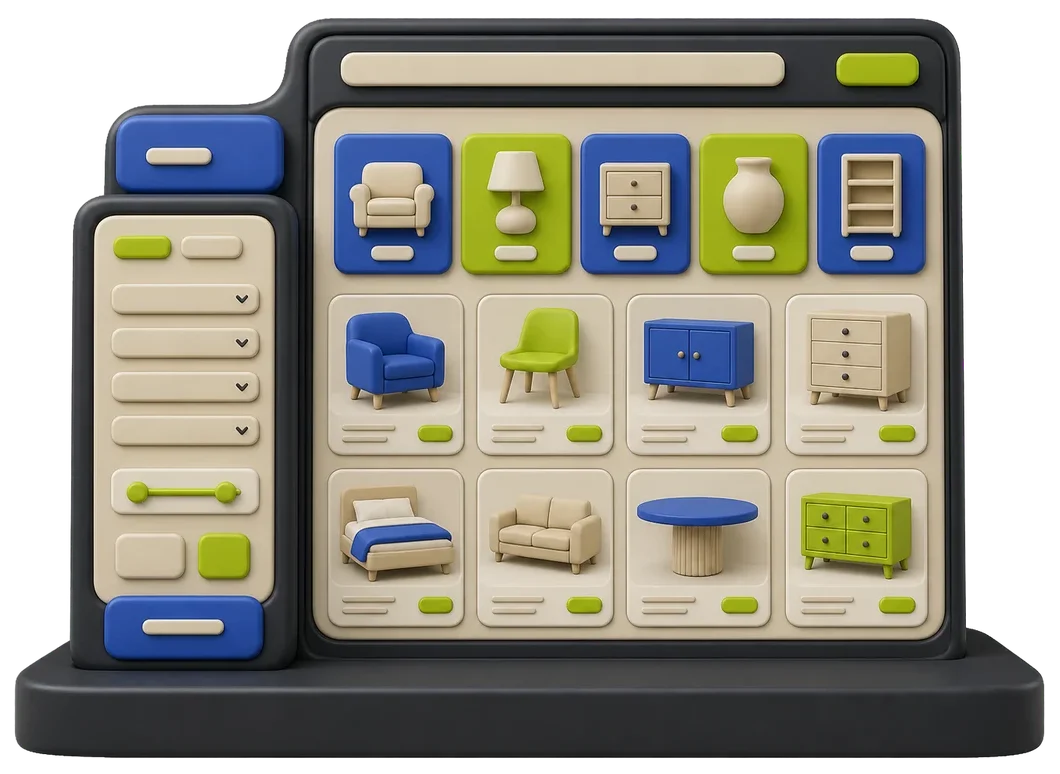


Development of a catalog site: a solution for a specific business task
Development of a catalog site is a structured online catalog of goods or services without mandatory online payment. This format is suitable for manufacturers, wholesale suppliers, B2B companies and businesses with a complex assortment. Its main task is to help the user quickly find a position, compare characteristics and send a request. Therefore, we do not start with a random template: we first clarify the product, the audience, the competitive environment and the success criteria.
At the consultation, we separate the mandatory functions from the desired ones and agree on what result the business should get. This protects the budget from unnecessary work, and the future page from chaotic blocks. We build the formulation in the language of the client: we explain the choice, remove practical objections and give enough facts so that a person can make a decision without calling “for clarification”.
Development does not start with the choice of technology, but with the business model and user tasks. We determine what information a person needs to receive, what can interfere with a decision, and what action is targeted. Only after that, the architecture, design and code are combined into one projected product.
What is included in the development of a directory site
The scope of work usually includes the following components:
The specific composition is fixed after the analysis. For one project, integration will be critical, for another — content, speed, or a complex mobile scenario. We tie all solutions to the task: to help the user quickly find a position, compare characteristics and send a request. That is why two projects with a similar name should not have the same structure.
- semantic structure of sections
- managed characteristics and filters
- informative item cards
- comparison and calculation request
- import and update of assortment
- landing pages for search demand
How we accept project solution
First, we collect the raw data and check the assumptions. Next, we create a structure, agree on the logic, prepare a visual or technical implementation and test key scenarios. The customer sees the intermediate results and understands what has already been done, what is being checked and what solution is required from the team.
We separately control the risk: building a catalog without a unified system of characteristics, due to which filters and SEO pages do not scale. These mistakes often seem minor at the start, but after launch they affect conversions, growth rate or organic visibility. We detect them before they become expensive to fix.
What affects cost and timing
The price does not depend on the number of drawn screens or the formal number of pages. Budget is affected by scope of research, complexity of content, integrations, non-standard scenarios, number of roles, migration requirements, and depth of testing. After a short brief, we form a clear estimate with stages, results and limits of responsibility.
Times are also determined not only by production speed. It takes time to agree on the structure, prepare materials and check. We plan the work so as not to transfer unresolved issues to the final stage. If the launch has a fixed date, we determine the priority MVP, and the development is carried out in subsequent iterations.
Verifiable quality
We evaluate the result by indicators that correspond to the task: transitions to cards, use of filters, price requests and the quality of B2B leads. Before the start, we fix the basic value, configure the events, and after the launch, we look not only at attendance, but also at the quality of user actions. This allows you to distinguish a real improvement from a beautiful but impractical update.
Technical quality includes correct display on current devices, clear navigation, accessibility of basic actions, valid forms and absence of critical errors. For search pages, we additionally check indexing, metadata, internal links, and compliance of the content with the real request.
How to prepare for the start
In order to quickly start developing a catalog site, prepare a brief description of the product, priority audiences, geography of work, a list of competitors and examples of communication that are close to you or, conversely, not suitable. If there are analytics, an old website, advertising reports or a brand book, they will help you make more accurate decisions.
You don’t need to write a technical task for dozens of pages yourself. It is enough to explain the business context, constraints and expected result. We will ask clarifying questions, form a structure of requirements and offer a sequence of works without unclear technical formulations.
Working with the result after launch
Publication does not complete work with the result. For the “Development of a catalog site” direction, it is important to check the behavior of real visitors, the correctness of analytics and indicators: conversions to cards, use of filters, price requests and the quality of B2B leads. Early data helps to see where the audience hesitates, what arguments work and what should be improved in the next iteration. Instead of chaotic edits, we form a short list of hypotheses, evaluate their potential impact, and implement changes one at a time. This way, the business understands why the resource is spent and how each refinement is related to the original goal – to help the user quickly find a position, compare characteristics and send a request.
Related services and the next step
Among the logical next steps for such a project are price for the development of an online store, collection of the site’s semantic core and turnkey information site development. This is not a random list: each landing page explains in detail the individual service, its composition and relevance to the business.
Describe the task, current status and desired launch date. At the first conversation, we will explain what format is appropriate for the development of a catalog site, what should be included in the first version and what data is needed for an accurate assessment. You will get a clear plan without pressure and promises that cannot be verified.